
There is this house — a 1.5-storey circa-1900 structure with a clapboard exterior. It is slowly sinking into the ground. The sides are collapsing and folding inwards. The two leaded-glass windows on the second storey under the peaked roof are rebelliously, incongruously, straight and firm. They stand in contrast to the rest of the house, a mysterious series of sloping angles and walls, all leaning against each other and miraculously, still standing like a house of cards. It is as if the walls of this house refuse to go down without a fight. They are standing strong. Together.
I had been driving frequently past this irresistible house, joined to yet another building which looks uninhabited. But the thing I have to mention is: these two properties which are seemingly just one — are surrounded by stuff. Old engines, a mattress on the front verandah — thank goodness that mattress is encased in plastic to endure the elements. There are scooters, vehicles and snowmobiles and all miscellany of stuff. I want to stop and look. At first, I thought the property was abandoned. But it is not.
Now that it is spring, there are two men outside almost every time I drive by. They look as if they are at meaningful work as they stand there in the few square feet that is not filled with items. They stand in a small cleared space, a dolly at the ready. What could they possibly be moving, I wonder? Or perhaps there are more items arriving. Last week, on a warm summer day, I drove by and the two of them were sitting in the midst of the cacophony of items, enjoying a beverage. They looked relaxed and at peace. It made me envious of their obvious comfort and ease, surrounded by their stuff.
These days, most of us are self-flagellating over the accumulation of goods inside our homes and on our properties. As a realtor, I find myself often in the predicament of gently encouraging people to purge. Purge is such a violent word, isn’t it? Purge brings a picture to mind of someone flinging open the front door of their home and throwing everything onto the street.
As I pontificate to friends and clients on this age of stuff, consumerism, and the peace of mind that comes with removing the clutter from one’s home and one’s mind, I feel like I need to take my own advice. It is one of the mysteries of life that even though I give away items, my home does not feel lighter in any way. Giving away half of my stock of switch plates, or some of my inventory of antique glass door knobs is not really changing much. Reviewing the contents of my kitchen drawer filled with all manner of extremely useful things, from tubes of hinge lubricant, shoelaces, little twists of string, Christmas tree bulbs, eye hooks, cuphooks and odd screws, a magnifying glass, BBQ skewers (I do not own a BBQ), batteries, several types of tape and those finicky bulbs for my under-the-counter lighting, I usually replace everything in the drawer carefully. I am a practical person, I tell myself. These are useful things.
The category of item that is most difficult to deal with is definitely the items to which memories are attached. That breadboard made by an ex-partner when things were still good. The silver-etched Birks vase that was one of my grandmother’s wedding gifts. The watercolour poppy painting that my mother loved. The tins with images of the King and Queen — also cherished by my mother. Queen Elizabeth and my mother were both born in 1926. That fact seemed to forge a connection. The antique iron that my father bought at the Lachute Flea Market. It holds the door open to my office. I somehow remember from whence I came when I walk in to my office each day.
I know they say that you can take photographs of things and then let them go. But that is absolute rubbish. You can only let things go if and when you are ready to let them go.
It occurred to me that we struggle to let things go for a simple reason: more than the memories they represent, there is a deeper worry that one day, we too will be forgotten.
By remembering the stories and the history of the things we cherish, we define and carve out our space in our homes, with our family, loved ones and friends. Our belongings tell the story of who we are.
This notion came to me as I signed in to this website. My user name popped up automatically, as did my password. And right underneath were the words, “Remember me.”
There it was. The reason we hold on to things. But don’t get me wrong. Some people collect things for different reasons. Filling one’s sanctuary with stuff can be a subliminal cushion from the cold, cold world or from an unhappy life. We busy ourselves keeping and storing and hoarding — which prevents us from literally creating enough empty space for the next chapter in life.
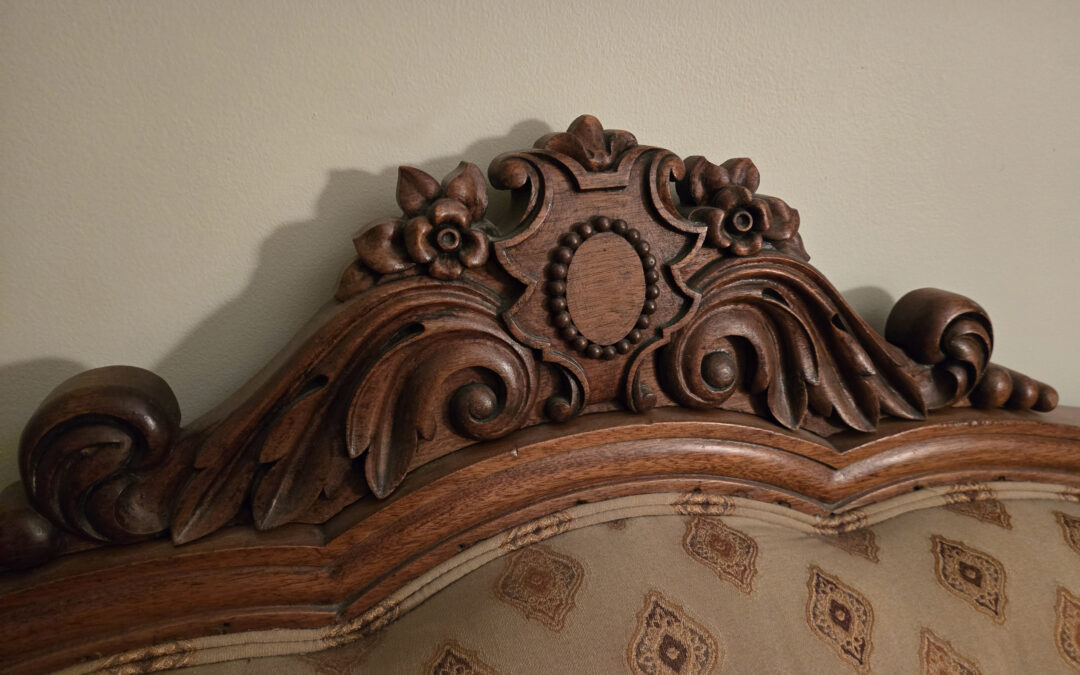
The 96-inch-long settee in my living room tilts forward, as if encouraging people to stand up and leave. It takes up an entire wall in my living room. My Vankleek Hill home, built in 1905, is not expansive. There are many rooms and they are not large. I paid a fortune to have this settee — known by family members as ‘the barge’ re-upholstered. It belonged to my great-great-grandmother, Maria Louisa Vankleek Pattee. You know what comes next. I cannot let this piece of furniture go. There is too much history there. What stories were told, as ladies perched on the edge of the lengthy seat, sharing secrets and worries? This piece of furniture tells me that we will endure — just as she did, running a farm without a husband, in times when that was not how things were done. I pass what I still think of as ‘her house’ daily and think of that settee, once in the front parlour.
And so, dear friends: pay no heed to my advice to de-clutter, downsize and reduce. I am the very last person who should give advice. I love the memories, the history, the quirky things, the art, the dishes, rocking chairs and all the rest of it.
And we pass these things on. My daughter will look at something in my home and ask, “Does that have a story?”
Yes, I say. And then I tell the story.
Recent Comments